
Hosted by Partnership of Historic Bostons
Part of the Metacom’s Resistance: Retelling King Philip’s War collection
Wednesday, March 11 from 7 pm to 8:30 pm EDT
King Philip’s War (1675-1678) has rightly been described as a watershed moment for the Native and Puritan inhabitants of New England. The history of this forgotten conflict is most often told through Mary Rowlandson’s famous captivity narrative and the victors’ monuments scattered in towns throughout New England. However, these settler sources distort our historical memory of the complex tensions that led to war, the political and environmental factors that shaped its course, and its diverse outcomes for Native communities across the Northeast.
In this talk, Kevin March re-examines King Philip’s War, offering a more nuanced picture of the conflict that reshaped New England.
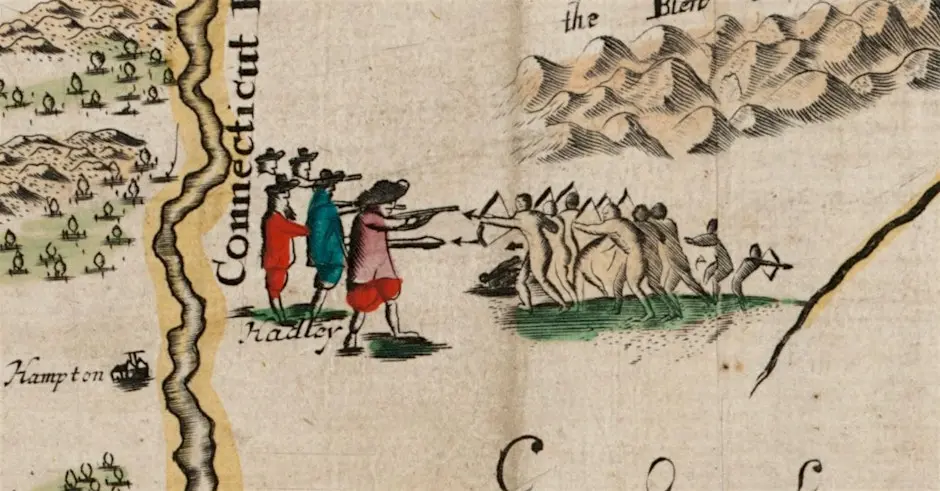
In June 1675, 50 years of Anglo-Indian tension erupted into conflict when the Wampanoag leader Metacom (King Philip) led a pan-Indian confederation against New England. In the summer and fall, Metacom’s coalition of Wampanoag, Nipmuc, Pocumtuck, Podunk, and Nashaway warriors raided English villages in southern Massachusetts, Rhode Island, and on the Connecticut River. A parallel war also erupted between the English settlers and Wabanaki Indians of Maine and New Hampshire.
In December, English soldiers and their Pequot and Mohegan allies launched a brutal campaign against the neutral Narragansetts, killing hundreds of men, women, and children in the Great Swamp Massacre. Bolstered by Narragansett survivors, Metacom launched a major raid on Plymouth in March 1676. But scarce provisions and infighting undermined his coalition, and the English slowly gained the initiative.
In August 1676, English and Mohegan rangers hunted down and killed Metacom at Mount Hope, Rhode Island, and his severed head was displayed at Plymouth. The English sold hundreds of Indian “traitors” into Atlantic slavery and dispossessed them of their lands. Yet Indian defeat was not universal. To the north, the Wabanakis were victorious, launching raids that “desettled” coastal Maine and allowed their leaders to dictate the terms of peace in April 1678.
This talk moves beyond narratives of “Indian rebellion” and Puritan conquest to offer a panoramic introduction to King Philip’s War. Following historian Lisa Brooks (Abenaki), this talk “unbinds” neat chronologies of the conflict, embracing its historical complexities and unevenness.
Kevin March begins by exploring the ongoing sources of conflict between Native and English communities, including disputes over property rights and political sovereignty. He will then examine the motives and decisions of Native peoples on both sides, including forgotten but crucial leaders like Weetamoo (Pocasset), Canonchet (Narragansett) Awashonks (Sakonnet), and Madockawando (Penobscot). He concludes by assessing the war’s diverse consequences for Native communities in the Northeast. Some groups suffered devastating losses, enslavement, and dispossession in the aftermath of King Philip’s War, but others retained their land rights and reasserted their political sovereignty for decades until the American Revolution.
As we approach the 350th anniversary of King Philip’s War, its meanings and legacies are still deeply contested. This talk will conclude with a brief examination of historical memories of the conflict. Puritan stalwarts like Cotton Mather labelled the war an “Indian rebellion,” but later historical reassessments have described the conflict as a “civil war,” and still others as a Native battle for survival and sovereignty. Popular narratives of this forgotten war still largely take the colonial perspective, but public history initiatives and collaborations between Native and settler scholars have begun to craft new histories of King Philip’s War. For them, King Philip’s War is more accuately seen as a war of resistance.
Kevin March is a history PhD candidate (ABD) at Boston College. He is interested in empire, property, and environmental history in New England and vast early America. Kevin’s dissertation explores how the Wabanaki peoples (Abenaki, Maliseet, Passamaquoddy, and Mi’kmaq) navigated the ecological, political, and cultural dimensions of contact with English and French settlers in the 17th century northeast. Trade records, property deeds, and wampum belts reveal complex connections between Wabanaki, English, and French actors. Kevin’s work has received generous support from the Massachusetts Historical Society, the Gilder Lehrman Institute, the Society of the Cincinnati, and the Clough Center for Constitutional Democracy at Boston College.

Did you discover the the Mattakeesett tribe, a branch of the Massachusetts tribe. ? I have a 8th
great grandmother, Meriah, born in 1668.
Because of age and health, I will not be able to attend,